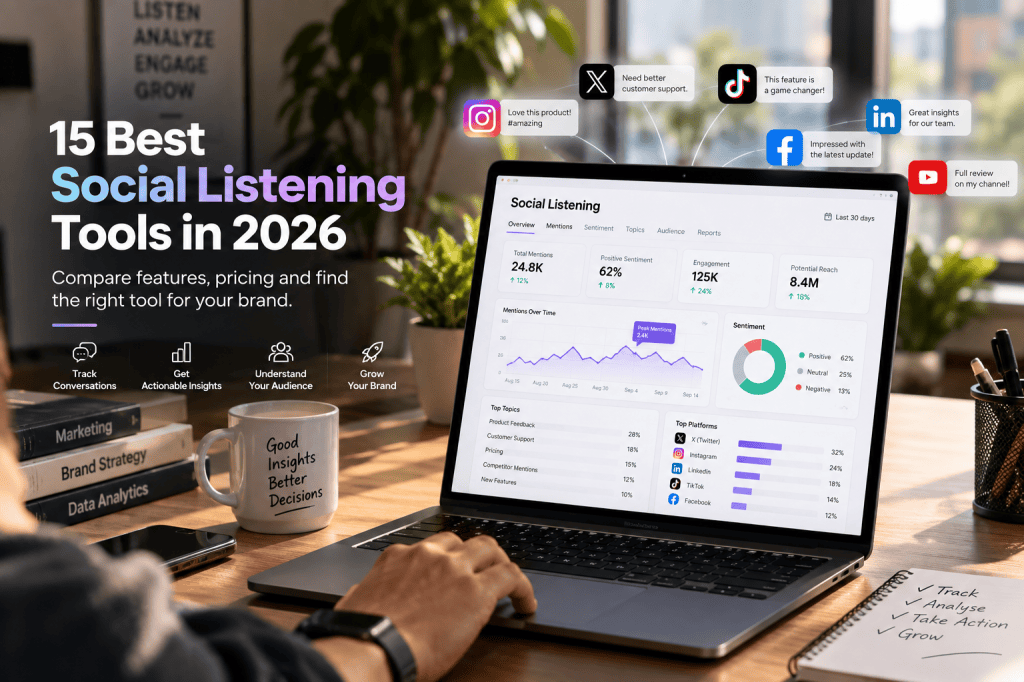
Social listening tools help brands understand what people are saying about their company, products, competitors, and industry across social networks and the wider web. But the right tool depends heavily on what you actually need to listen to: customer conversations, brand mentions, PR coverage, visual content, TikTok trends, competitor activity, or user-generated content.
For 2026, our shortlist includes Taggbox, Sprout Social, Hootsuite, Brandwatch, Meltwater, Brand24, Agorapulse, YouScan, Sprinklr, Pulsar, Keyhole, BuzzSumo, Awario, Exolyt, and Google Alerts.
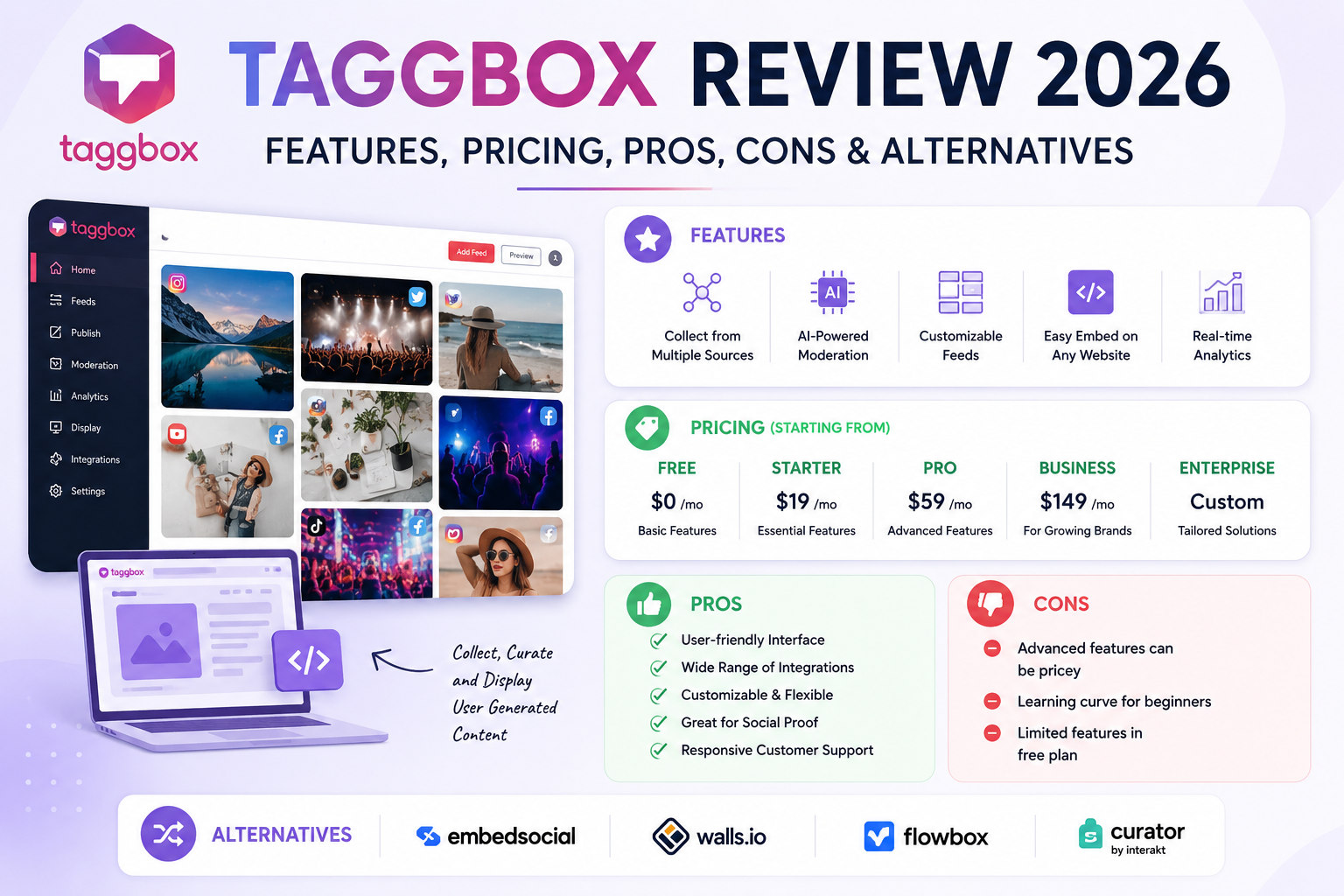
One important distinction: Taggbox is not a like-for-like replacement for enterprise consumer-intelligence platforms such as Brandwatch or Pulsar. Its strongest use case is collecting, moderating, analyzing, and publishing social content, UGC, reviews, hashtags, and mentions across websites, events, and digital displays. That makes it particularly relevant for brands that want to turn social conversations into visible social proof and marketing assets. Taggbox currently supports social feeds from 15+ platforms and offers moderation and analytics features alongside its reviews widget and social media wall products.
Pricing and G2 ratings in this article were checked against publicly available information in September 2026. Prices can change, particularly for enterprise products.
Quick comparison: the best social listening tools for 2026
| Tool | Best for | Starting/public price | Free option | G2 rating* |
|---|---|---|---|---|
| Taggbox | Social content, UGC, social walls & social proof | Free; paid from $19/mo | Yes | 4.8/5 |
| Sprout Social | Social management + listening | From $199/seat/mo | 30-day trial | 4.4/5 |
| Hootsuite | Social management + accessible listening | Public plans available; advanced listening varies by plan | 14-day trial | 4.3/5 |
| Brandwatch | Consumer research & deep social intelligence | Custom | No public free tier | 4.4/5 |
| Meltwater | PR, media intelligence & social | Custom | Demo/trial options vary | 4.1/5 |
| Brand24 | Brand monitoring for growing teams | $249/mo monthly | 14-day trial | 4.6/5 |
| Agorapulse | Social management with listening add-on | From $99/user/mo | Free plan/trial | 4.5/5 |
| YouScan | Visual social listening | $499/mo annually | Trial | 4.7/5 |
| Sprinklr | Enterprise customer experience | Custom | Demo | 4.1/5* |
| Pulsar | Audience & narrative intelligence | Custom | Demo | 4.3/5 |
| Keyhole | Hashtags, campaigns & influencer tracking | Custom | Trial/options vary | 4.3/5 |
| BuzzSumo | Content trends and media monitoring | From $199/mo on annual billing | Trial/free options vary | 4.5/5 |
| Awario | Budget-friendly web/social monitoring | $49/mo or $29/mo annually | 7-day trial | 3.9/5 |
| Exolyt | TikTok analytics & listening | $400/mo or $330/mo annually | Free plan | 4.7/5 |
| Google Alerts | Basic free monitoring | Free | Yes | N/A |
*G2 ratings are user-review averages, not independent measures of listening accuracy or overall product quality. Ratings and review counts change over time. Taggbox’s G2 product page currently shows 4.8/5 from 87 reviews; Sprout Social 4.4/5; Hootsuite 4.3/5; Brandwatch Consumer Intelligence 4.4/5; Brand24 4.6/5; YouScan 4.7/5; Pulsar 4.3/5; Keyhole 4.3/5; BuzzSumo 4.5/5; and Awario 3.9/5.
What Are Social Listening Tools?
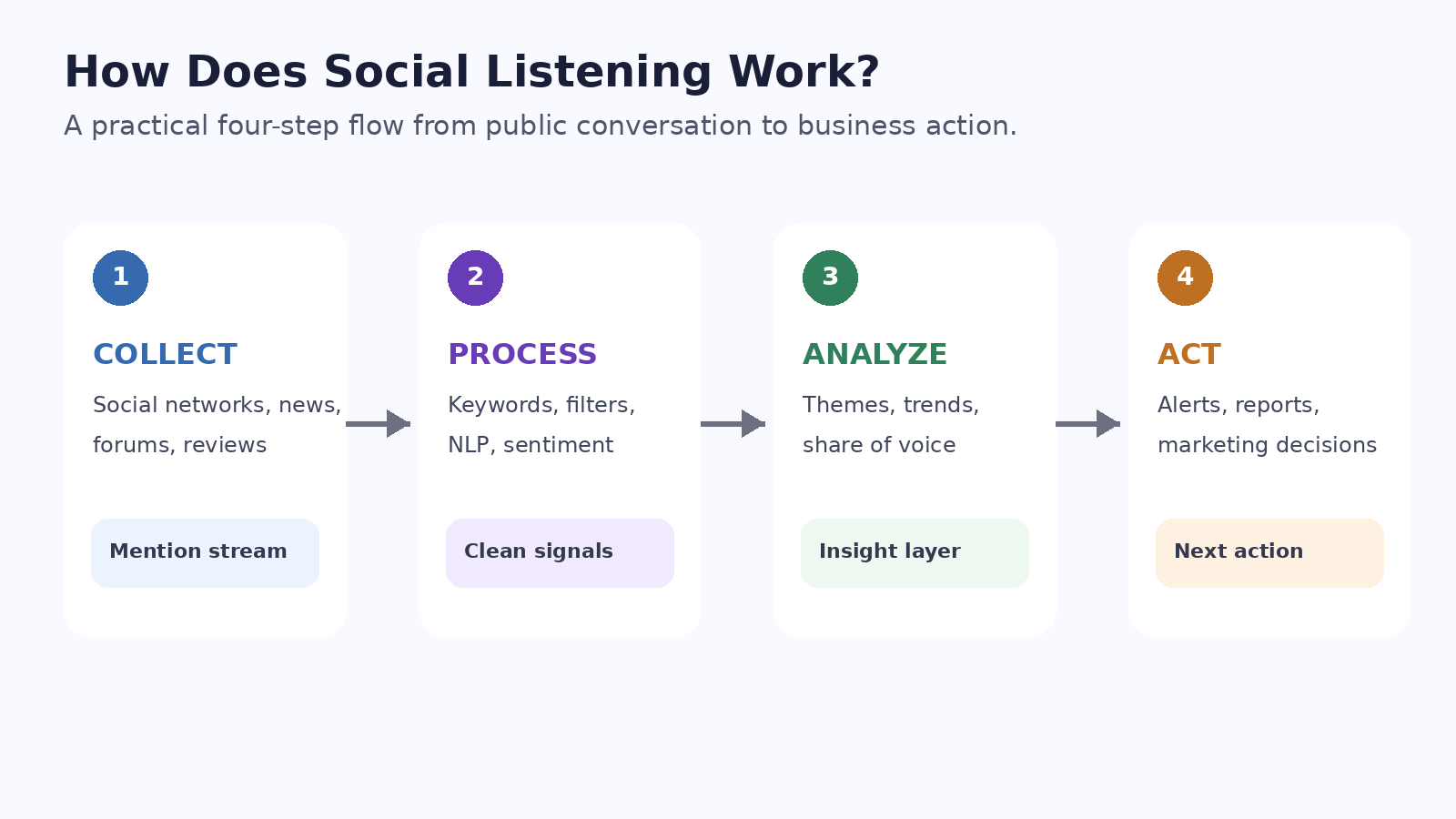
Social listening tools are software platforms that collect online conversations about a brand, product, competitor, topic, or industry and turn that data into actionable insights.
Instead of manually searching social networks for mentions, a listening platform can continuously monitor keywords, hashtags, public mentions, news, blogs, forums, reviews, and other supported sources. Depending on the product, it can then analyze sentiment, conversation volume, emerging topics, influencers, audience characteristics, competitive share of voice, and potential reputation issues.
The important word is analysis.
Simply finding a brand mention is monitoring. Understanding why people are talking about the brand, what themes are increasing, which audiences are driving the conversation, and what the marketing or product team should do next is social listening.
Taggbox illustrates one part of this ecosystem particularly well. Its social media feed widget solutions collects social posts, mentions, hashtags, reviews, and UGC from 15+ platforms, lets marketers moderate that content, and publishes it as live social proof on websites, events, and other digital experiences.
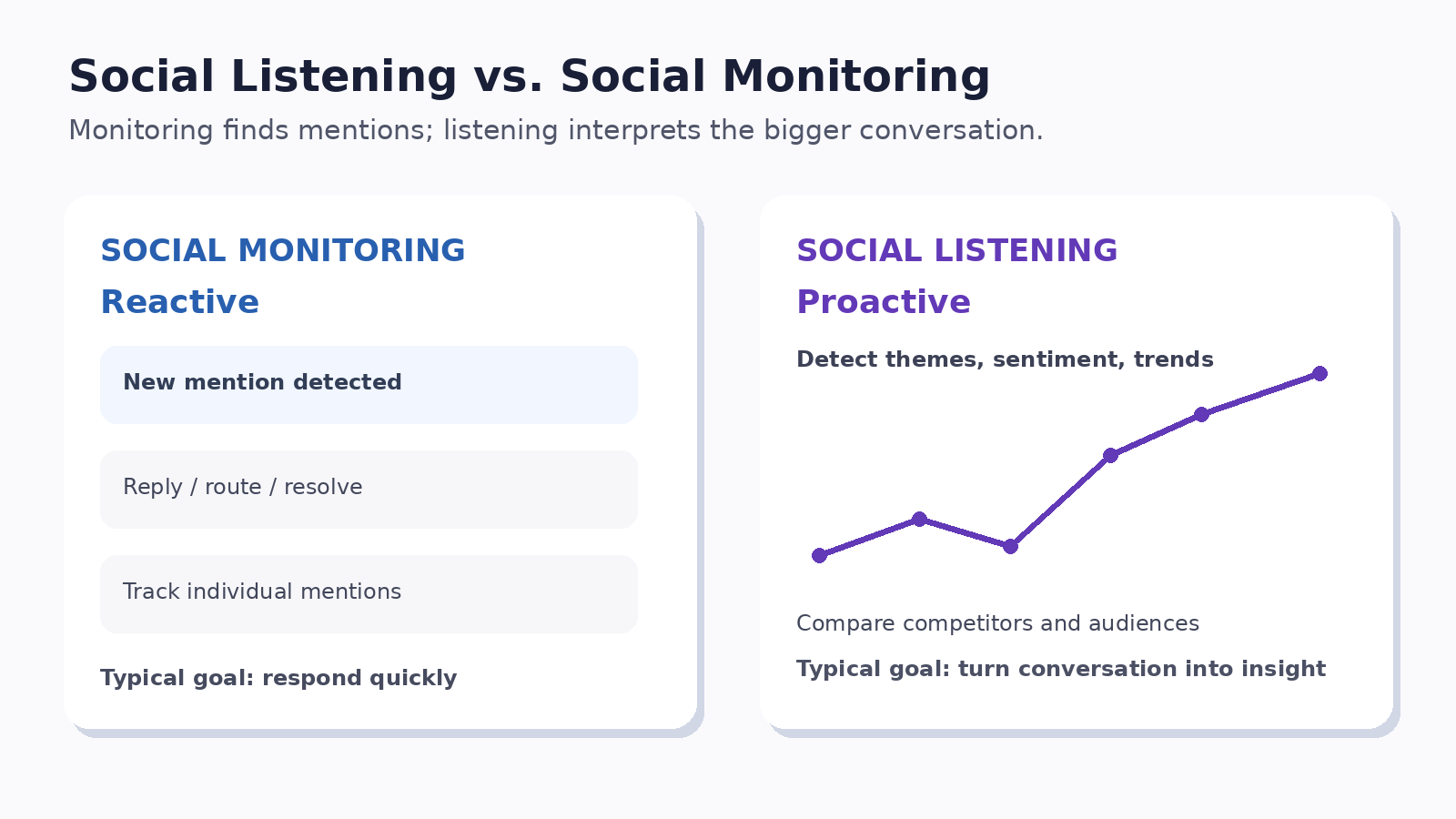
Social listening vs. social monitoring
| Social monitoring | Social listening |
|---|---|
| Finds individual mentions | Analyzes patterns across conversations |
| Usually reactive | Usually proactive |
| Answers “Who mentioned us?” | Answers “What is changing in the conversation?” |
| Focuses heavily on alerts and responses | Focuses on insights and decisions |
| Often used by social/community teams | Often used by marketing, PR, research and product teams |
The two overlap. In practice, good social listening platforms normally contain monitoring features, but a monitoring tool does not automatically provide full social intelligence.
How We Chose These Social Listening Tools
“Best social listening tools” lists have a transparency problem: many are published by software vendors themselves, which creates an obvious incentive to put their own product at the top.
That is why the methodology here is deliberately practical.
We looked at publicly available product documentation, current pricing information, G2 review data where available, and the specific job each tool is designed to perform. We also avoided presenting unverified capabilities as fact.
The main criteria were:
Source coverage: Does the tool monitor social networks, websites, news, forums, reviews, or specialist sources?
Query flexibility: Can marketers search using keywords, Boolean operators, hashtags, mentions, filters, locations, languages, or visual attributes?
Analysis: Does it go beyond a stream of mentions into sentiment, trends, themes, audiences, share of voice, or competitive intelligence?
Historical data: Can you investigate what happened before the day you created a query?
Alerts: Can teams catch spikes, reputation issues, or emerging conversations quickly?
Workflow: Can insights move into reports, team workflows, customer care, PR, or marketing?
Price transparency: Is there a publicly visible price, or will you need a sales conversation?
Actual fit: A tool should not be called “the best” for everybody. A specialist TikTok platform and an enterprise consumer-intelligence suite solve different problems.
That last point matters most.
The 15 Best Social Listening Tools for 2026
1. Taggbox — Best for Social Content, UGC and Social Proof
Taggbox takes a different approach to social listening than traditional consumer-intelligence platforms.
Rather than positioning itself primarily as a huge social-data research database, Taggbox focuses on collecting, curating, moderating, analyzing, and publishing social content and UGC.
Social Walls and Taggbox widgets can collect posts using hashtags, mentions, handles and other source types from 15+ platforms, including Instagram, Facebook, LinkedIn, X, TikTok and YouTube. That content can then be moderated and displayed on websites, events and digital screens.
That distinction makes Taggbox particularly useful for brands that want to turn conversations into something customers can actually see.
For example, an event organizer can collect attendee posts around a hashtag and display approved posts on venue screens. An ecommerce brand can collect UGC and reviews and publish them next to products. A marketing team can embed social feeds directly into a website instead of sending visitors back to individual social networks.
Taggbox also provides analytics around social-wall engagement and web performance, including interaction and sentiment-related measurements.
Pricing: Taggbox’s current website-widget plans include a free plan, Starter from $19/month, Growth from $39/month, and Advanced from $99/month, with enterprise pricing available for customized requirements.
G2: 4.8/5 based on 87 reviews on the current Taggbox product listing.
Pros
- Strong combination of social aggregation, UGC, moderation and publishing.
- Accessible pricing compared with enterprise social-intelligence suites.
Cons
- It is not designed to replace a deep enterprise consumer-research archive.
- Buyers looking for large-scale competitive intelligence should compare it with dedicated listening platforms.
What users say: Recent G2 reviews frequently highlight ease of use, customization, social-feed integration and responsive support.
Best fit: Brands, ecommerce teams, agencies and event marketers that want to collect social content and turn it into visible social proof.
2. Sprout Social — Best All-in-One Platform for Social Teams
Sprout Social combines publishing, engagement, reporting, social management and monitoring.
Its current Standard plan starts at $199 per seat per month and includes keyword and location monitoring. Professional is $299 per seat/month and Advanced is $399 per seat/month when billed annually. Sprout also offers a 30-day trial without requiring a credit card.
The important caveat is that Sprout is not simply a “social listening database.” It is a broader social-management platform. That is valuable for teams that want listening connected directly to publishing and engagement workflows.
Its current capabilities include sentiment-related functionality, competitor insights, reporting, collaboration and AI-assisted workflows.
G2: 4.4/5. Reviewers frequently mention ease of use, scheduling, analytics and centralized management, while pricing is also a recurring concern in G2 feedback.
Best fit: Social teams that want listening and publishing in one platform.
Who shouldn’t buy it: A small business that only needs inexpensive brand-mention monitoring may be paying for much more platform than it actually needs.
3. Hootsuite + Listening — Best for Teams Already Using Hootsuite
Hootsuite is another social-management platform that has pushed listening deeper into its product.
Its current plans include listening capabilities, while Enterprise adds more advanced listening and access to listening powered by Talkwalker. Hootsuite’s current documentation describes monitoring of mentions, competitors, trends, hashtags and sentiment.
Hootsuite Standard currently includes its Lumen listening functionality for monitoring mentions and sentiment, with a seven-day search window. Advanced expands the listening capability and provides a 30-day search window, while Enterprise offers premium listening with additional data sources and up to 13 months of historical data.
Hootsuite has also added newer-network listening capabilities. Its documentation currently covers Bluesky listening, while its June 2026 product update introduced keyword listening for public Threads conversations with historical backdata.
G2: 4.3/5.
Best fit: Teams that already use Hootsuite for publishing and want listening without adopting a separate primary platform.
Who shouldn’t buy it: Research teams looking for the deepest possible consumer-intelligence archive should compare Hootsuite with Brandwatch, Pulsar and similar specialist products.
4. Brandwatch — Best for Deep Consumer Research and Historical Analysis
Brandwatch is built much more around consumer intelligence than basic social monitoring.
Its Consumer Intelligence product is designed for researchers and analysts who need to search large volumes of online conversation, segment audiences, build dashboards, analyze conversations and automate reporting. Brandwatch currently describes its platform as providing access to billions of conversations and a large archive of consumer opinion.
G2 currently lists Brandwatch Consumer Intelligence at 4.4/5, with buyers particularly discussing its query depth, historical data and API capabilities.
Public pricing is not available as a simple self-serve plan. G2 currently shows the product as On Request, while Brandwatch directs prospects toward sales/demo discussions.
Pros
- Deep research capabilities.
- Designed for large-scale consumer and market analysis.
Cons
- Pricing is not transparent.
- The platform can be excessive for basic brand monitoring.
Best fit: Enterprise insights, research, brand and strategy teams.
5. Meltwater — Best for PR, Media Intelligence and Social in One Platform
Meltwater is particularly relevant when social listening is only one part of the communications problem.
Its platform brings together media intelligence, social listening, media relations, influencer marketing and other intelligence capabilities. Current pricing is customized based on modules, source coverage, data volume, regions, users, integrations and contract terms.
Meltwater’s own July 2026 pricing guide says public indicative ranges can start around $10,000/year for Starter, $25,000/year for Pro, and around $130,000/year for Enterprise, but emphasizes that final pricing depends on the customer’s configuration and contract.
G2: 4.1/5 across 3,000+ reviews on its current seller profile.
Best fit: PR teams, communications teams and larger organizations that need media monitoring alongside social intelligence.
Who shouldn’t buy it: A small company that only needs to know when customers mention its brand online.
6. Brand24 — Best for Straightforward Brand Monitoring
Brand24 is one of the more approachable platforms in this category.
It focuses heavily on tracking brand, product, competitor and industry mentions across online sources, with features such as sentiment analysis, real-time monitoring, AI insights and reports.
Its current pricing is considerably different from many older comparison articles. The Individual plan is $249/month, or $199/month when billed annually. Team starts at $349/month, Pro at $499/month, Business at $699/month and Enterprise from $1,499/month. Brand24 also offers a 14-day trial.
G2: 4.6/5 based on more than 300 reviews.
Recent G2 reviews mention real-time monitoring, review-site coverage, alerts, reports and AI features as useful parts of the product.
Best fit: Small and mid-sized marketing teams that want a dedicated monitoring tool without buying a much larger enterprise suite.
Who shouldn’t buy it: Organizations that need sophisticated consumer research across enormous historical datasets may need a more specialized enterprise platform.
7. Agorapulse Listening — Best for Social Management Plus Listening
One important 2026 change affects Mention.
Mention’s help center states that as of July 1, 2026, Mention is no longer sold as a standalone product. Existing customers can retain their plans, while Agorapulse Listening is positioned as its successor for advanced monitoring, reporting and competitive intelligence.
Agorapulse’s Advanced Listening capability monitors brand, competitor and industry conversations and can search across social networks, blogs, forums and news sources. It supports regular and competitive listening searches and offers up to 24 months of historical data according to the company’s current product documentation.
The current Agorapulse plans start at $99/user/month monthly or $79/user/month annually for Standard. Advanced Listening is sold as an add-on, currently priced at $100 per listening search per month according to Agorapulse’s documentation.
G2: 4.5/5.
Best fit: Existing Agorapulse customers or social teams that want management, reporting and listening under one roof.
8. YouScan — Best for Visual Social Listening
YouScan stands out because it goes beyond text-based monitoring.
Its platform combines social listening with visual intelligence, allowing businesses to analyze images and identify brand logos, products and visual contexts appearing in social content.
YouScan’s current Starter pricing is $499/month billed annually and includes three topics, up to 15,000 monthly mentions, social, blog, forum, review and online-news coverage, plus AI-powered Insights Copilot. Its higher-tier plans add unlimited topics, image-content analysis, audience insights, API access and other enterprise features.
G2: 4.7/5 based on more than 280 reviews on the current product page.
Recent G2 feedback highlights its broad source coverage and visual/TikTok listening capabilities, while some users mention a learning curve for more advanced functions.
Best fit: Consumer brands where people post products visually rather than mentioning brand names in text.
Think fashion, beauty, food, automotive, electronics and lifestyle brands.
9. Sprinklr — Best for Enterprise Customer Experience
Sprinklr is difficult to compare with a lightweight listening product because social listening is part of a much larger enterprise CX and marketing ecosystem.
Sprinklr’s platform brings together listening, marketing, engagement, customer service, analytics and workflow capabilities. Its Social Listening offering is intended to analyze conversations around brands, competitors and industries while connecting those insights to broader enterprise workflows.
Pricing is custom and designed around enterprise requirements.
G2: The Sprinklr Marketing product currently carries a 4.1/5 rating on G2.
Best fit: Large enterprises that need social listening connected to customer experience, service, marketing and governance.
Who shouldn’t buy it: A team that simply needs keyword alerts and basic sentiment analysis.
10. Pulsar — Best for Audience and Narrative Intelligence
Pulsar goes beyond asking how many times a brand was mentioned.
Its TRAC platform focuses on audience intelligence, community mapping, narrative analysis, cultural context and social listening. Pulsar says TRAC ingests public conversation across more than 45 source types and supports audience segmentation and narrative tracking.
The platform is enterprise-priced, with quotes based on factors including users, data volume, source coverage, language, geography, support and integrations.
G2: 4.3/5.
Recent G2 feedback discusses Pulsar’s visualizations, audience analysis, topic insights and depth of social data, while some reviewers mention the learning curve associated with a powerful research platform.
Best fit: Consumer insights, research, cultural intelligence, large agencies and enterprise strategy teams.
11. Keyhole — Best for Hashtag and Campaign Tracking
Keyhole is particularly useful when your listening requirement starts with a campaign rather than a massive brand-intelligence program.
Its capabilities include hashtag tracking, keyword listening, influencer analysis, sentiment, competitor comparison and campaign reporting.
Its current plan documentation describes a Team plan with five listening topics and 10,000 posts, while Enterprise expands topic and post limits and adds capabilities such as historical data, influencer analytics and white-label dashboards. Pricing is not shown as a simple public figure on the current plan page.
G2: 4.3/5.
G2 reviewers frequently mention its usability and campaign/hashtag reporting. Some reviewers also question value at higher tracking volumes, which is worth considering before choosing it for large-scale listening.
Best fit: Campaigns, conferences, hashtags, influencers and social reporting.
12. BuzzSumo — Best for Content and Trend Research
BuzzSumo isn’t a traditional reputation-management platform, but it belongs in a serious social listening toolkit because it connects social engagement, content research, media monitoring and trend discovery.
Its Content Analyzer can investigate content performance around keywords, topics, URLs and domains. BuzzSumo also includes media alerts and monitoring for brands, competitors and industry updates.
Current public pricing includes Content Creation at $199/month when billed annually, PR & Comms at $299/month, Suite at $399/month and Enterprise at $999/month.
G2: 4.5/5.
Best fit: Content marketers, SEO teams, PR professionals and agencies that want to understand which topics and stories are gaining attention.
Who shouldn’t buy it: Teams whose primary requirement is customer sentiment or full brand-health monitoring.
13. Awario — Best Budget-Friendly Monitoring
Awario is focused on brand and competitor mentions across social media and the wider web.
Its current Starter plan is $49/month, or $29/month when billed annually. Pro is $149/month, and Enterprise is $399/month, with discounts for annual billing. The plans include different limits for topics, mentions and users.
Awario also supports Boolean search, exports, PDF reports, white-label reporting and API access on its higher plans.
G2: 3.9/5 based on the current G2 product listing.
This is a good example of why price and review score should not be treated as interchangeable metrics. G2 reviews praise Awario’s affordability and usability, while some recent reviews raise concerns about data accuracy and support.
Best fit: Smaller teams that need basic listening capabilities without immediately moving into enterprise pricing.
14. Exolyt — Best for TikTok-Centric Listening
Exolyt is designed specifically around TikTok analytics and intelligence.
Its current free Basic plan supports one tracked TikTok account and one hashtag but does not include social-listening projects. Essentials costs $400/month, or $330/month when billed annually, and includes three social-listening projects. Advanced costs $950/month, or $790/month annually, with 15 listening projects plus features such as sentiment analysis and video transcription.
G2: 4.7/5, although the review sample is much smaller than larger platforms.
A recent G2 reviewer specifically described using Exolyt for TikTok trend research, hashtag tracking and social listening.
Best fit: Brands, creators and agencies whose listening strategy is heavily TikTok-driven.
15. Google Alerts + Search — Best Free Starting Stack
Google Alerts is not a full social listening platform, and it shouldn’t be presented as one.
But it remains useful for free monitoring of public web mentions.
Google’s official documentation allows users to create alerts for topics such as news, products or mentions of their name. Users can control factors such as frequency, source type, language, region and result volume.
A simple free monitoring stack can combine Google Alerts with platform-native search tools such as X search.
The limitation is obvious: this approach lacks the unified dashboards, social data collection, sentiment analysis, historical archives, competitive benchmarking and workflow automation available in dedicated listening platforms.
Best fit: Freelancers, startups and individuals who want basic awareness without paying for software.
Social Listening Tool Pricing: What Will You Actually Pay in 2026?
This is where many comparison articles become unreliable because they recycle old pricing pages.
There is no standard social-listening price.
The market currently ranges from free monitoring tools to enterprise contracts that can reach five or six figures annually.
| Price level | Examples | What to expect |
|---|---|---|
| Free | Google Alerts, Taggbox Free, Exolyt Basic | Basic monitoring or limited platform access |
| <$100/mo | Taggbox, Awario | SMB-focused monitoring, aggregation or social-content workflows |
| $100–$300/mo | Sprout Social, Agorapulse, Brand24 entry tiers | Broader management/listening capabilities |
| $300–$1,000/mo | YouScan, Exolyt higher tiers, BuzzSumo | Larger data volumes, research, advanced analytics |
| Enterprise/custom | Brandwatch, Meltwater, Pulsar, Sprinklr | Large datasets, governance, APIs, support and custom coverage |
Taggbox currently has a free option and paid website-widget plans beginning at $19/month.
Sprout Social starts at $199 per seat/month under its current published pricing.
Brand24 currently starts at $249/month monthly, while its annual Individual plan is $199/month.
YouScan’s current Starter plan is $499/month billed annually.
Meanwhile, Brandwatch and Pulsar use custom enterprise pricing, and Meltwater explicitly says pricing depends on the selected modules, coverage and contract.
The most important pricing lesson is this:
Don’t compare monthly subscription prices without comparing data coverage and historical access.
A cheaper platform that misses the conversations you care about can cost more in lost insight than an expensive platform that gives your team reliable data.
What Changed in Social Listening in 2025–2026?
Platform coverage is becoming part of the buying decision
The social network landscape has changed significantly.
Threads and Bluesky are now relevant listening sources for brands that want to understand conversations outside the traditional Facebook, Instagram, YouTube and X ecosystem.
Hootsuite, for example, currently documents Bluesky listening and added public Threads keyword listening in 2026.
The lesson is simple:
Never buy a listening platform based solely on a logo list.
Ask exactly what can be searched.
Can you monitor hashtags?
Can you monitor public mentions?
Can you search historical data?
Can you search comments?
Can you analyze sentiment?
Can you access the data in the countries and languages your customers use?
Can you monitor the specific source that matters to your industry?
These distinctions matter more than the number of social-network icons on a vendor’s homepage.
TikTok listening is becoming more important
TikTok has moved from being a channel primarily considered for publishing into an important source of consumer and cultural signals.
Specialist products such as Exolyt now offer dedicated TikTok social-listening capabilities, while other platforms increasingly incorporate TikTok into broader monitoring and intelligence workflows.
The practical point for buyers is to check exactly what “TikTok monitoring” means.
A platform may support account analytics without offering broad keyword listening.
Another may monitor hashtags without giving you historical comments.
A third may offer visual analysis in addition to text-based listening.
These are not interchangeable capabilities.
AI is becoming an interface, not a magic data source
AI is now deeply embedded in social listening.
Modern tools can summarize conversations, identify themes, classify sentiment, surface anomalies, help build queries, generate reports and answer natural-language questions.
But there is still a basic rule that hasn’t changed:
AI cannot compensate for missing or poor-quality source data.
If your tool doesn’t collect an important conversation source, an AI summary of the data it does collect will not solve the blind spot.
That is why experienced teams should evaluate AI after evaluating source coverage, query quality and historical access.
Which Social Listening Tool Is Best for You?
There isn’t one correct choice for every business.
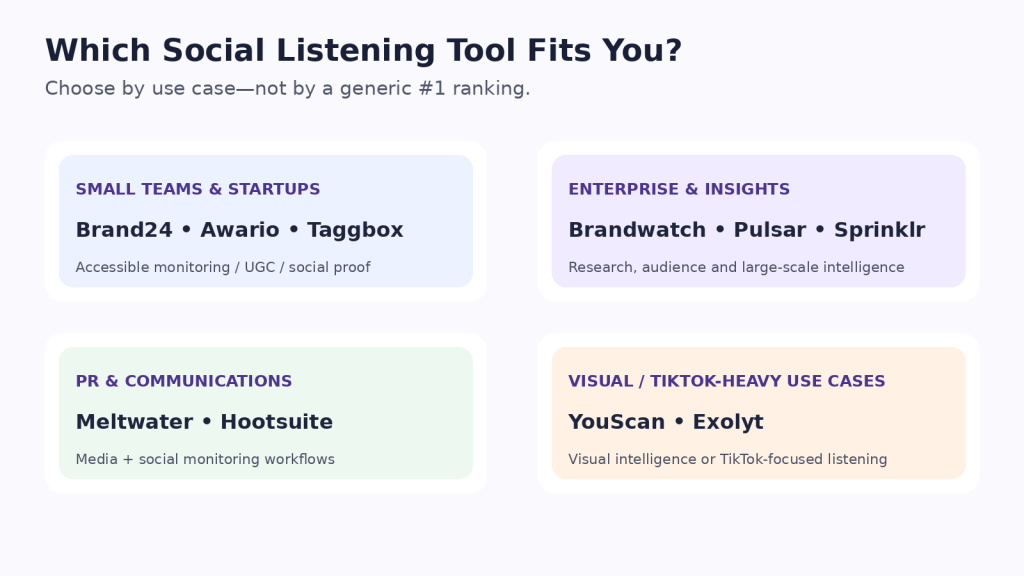
For small teams and startups
Look at Brand24, Awario, Taggbox or Agorapulse, depending on the job.
Brand24 is designed around brand and online conversation monitoring. Awario offers a relatively accessible entry point for keyword and mention tracking. Taggbox makes more sense when your goal is to collect and publish social content, UGC and reviews as marketing assets. Agorapulse works particularly well for teams already using its broader social-management platform.
For enterprise research and insights
Look at Brandwatch, Pulsar, YouScan, Meltwater or Sprinklr.
Here the selection should be driven by data scale, source coverage, historical requirements, audience intelligence, security, governance, API requirements and the number of teams that will consume the output.
For PR and communications
Meltwater is particularly relevant because social listening sits alongside media intelligence and PR workflows.
For visual brands
YouScan deserves particular attention because visual analysis is one of its central differentiators.
For TikTok-heavy strategies
Exolyt is the specialist option in this list, with dedicated TikTok analytics and social-listening projects.
For UGC, social walls and social proof
Taggbox is the more relevant choice when the business objective is not simply “listen to conversations” but collect social content, moderate it and put it to work.
For example:
- Display customer posts at an event.
- Embed Instagram or TikTok content into a website.
- Turn customer content into UGC galleries.
- Collect reviews and display them as social proof.
- Build hashtag walls around campaigns.
- Use social content in digital displays.
- Create shoppable UGC experiences.
Taggbox currently supports collection from 15+ social platforms and provides moderation, customization and analytics functionality around those feeds.
How to Get Started With Social Listening
Buying the tool is not the first step.
The first step is deciding what information you actually need.
1. Define what you want to hear
Start with business questions rather than random keywords.
For example:
- What are customers saying about our product?
- What complaints are increasing?
- What are people saying about our competitors?
- Which industry topics are trending?
- Which customer groups are talking about us?
- Which campaigns are generating UGC?
2. Build a monitoring universe
Include:
Brand terms: company name, product names, executives, common misspellings.
Competitors: brand names, products and campaign terms.
Industry terms: category keywords, emerging terminology and customer problems.
Campaign terms: hashtags, slogans, event names and launch terms.
Don’t create thousands of keywords simply because the software allows it.
The goal is signal, not volume.
3. Trial two or three platforms
Set up the same monitoring project in two or three tools.
Measure:
- How many relevant mentions are found?
- How much irrelevant noise appears?
- How good is sentiment classification?
- How easy is the query builder?
- How far back can you search?
- What sources are missing?
- Can reports be shared with decision-makers?
This comparison is usually more valuable than reading another “Top 10” list.
4. Establish a baseline
You need a baseline before you can identify a meaningful increase.
Track things such as:
- Mention volume
- Sentiment
- Share of voice
- Engagement
- Influencer activity
- Top conversation themes
- Competitor visibility
Without a baseline, every spike looks important.
5. Route insights to the right team
Listening becomes valuable when the insight goes somewhere.
Negative product feedback may belong with product management.
A PR issue may belong with communications.
A recurring customer question may become an SEO topic.
A competitor feature complaint may become a sales insight.
A sudden increase in UGC may become a marketing campaign.
The goal isn’t to create another dashboard.
The goal is to make better decisions.
Frequently Asked Questions
What is the difference between social listening and social monitoring?
Social monitoring focuses primarily on finding and tracking mentions, messages and conversations. Social listening analyzes those conversations to identify broader patterns such as sentiment, themes, trends, audience behavior and competitive signals. In practice, most serious social listening platforms include monitoring functionality as part of a larger analysis workflow.
How much do social listening tools cost?
Pricing ranges from free tools such as Google Alerts to enterprise platforms with custom contracts. Current public examples include Taggbox from $19/month, Awario from $49/month monthly, Brand24 from $249/month monthly, Sprout Social from $199 per seat/month, and YouScan from $499/month when billed annually. Enterprise products such as Brandwatch, Meltwater, Pulsar and Sprinklr generally use customized pricing.
Are there any free social listening tools?
Yes, although free tools are usually much more limited. Google Alerts can send email notifications when new Google Search results appear for a topic. Taggbox also offers a free product plan for limited social/review feed use, while Exolyt offers a free TikTok analytics tier.
Which social listening tools are enterprise-ready?
Brandwatch, Meltwater, Pulsar, Sprinklr and YouScan are examples of platforms designed for larger research, marketing, PR or customer-intelligence programs. Enterprise readiness should be evaluated based on source coverage, historical data, governance, APIs, integrations, user permissions, security and reporting rather than brand size alone.
Can you do social listening on TikTok?
Yes, but the exact capability depends on the platform. Exolyt provides dedicated TikTok social-listening projects, while Taggbox supports TikTok feed collection for social walls and content aggregation. Buyers should distinguish between account analytics, hashtag monitoring, content collection and broader conversational listening because they provide different types of data.
Do social media management tools include social listening?
Many now do, but the depth varies considerably. Hootsuite includes listening capabilities in its current plans and offers more advanced listening at higher levels. Sprout Social includes monitoring and listening-related functionality within its social-management platform. Agorapulse sells Advanced Listening as a dedicated add-on.
What is social listening used for?
Common uses include reputation monitoring, customer feedback, competitive research, trend discovery, campaign analysis, crisis detection, identifying influencers, product feedback and finding opportunities in customer conversations.
The important step is connecting those insights to an action. A trend that nobody acts on is just another dashboard metric.
Final Verdict
The best social listening tool depends on what you want to listen to and what you plan to do with the information.
Taggbox is particularly relevant for brands that want to collect social content, UGC, reviews, hashtags and mentions and turn them into social walls, website content, digital experiences and social proof. It is a different proposition from enterprise consumer-intelligence platforms, and that is precisely why it can be a better fit for content-led marketing and UGC use cases.
Sprout Social and Hootsuite make sense for social teams that want publishing, engagement, analytics and listening connected together.
Brandwatch and Pulsar are built more around deep consumer, audience and narrative intelligence.
Meltwater is particularly relevant to organizations where media intelligence and PR matter alongside social.
Brand24 and Awario provide more approachable ways to monitor online conversations, while YouScan differentiates itself through visual listening.
And when you simply need basic awareness without a software budget, Google Alerts remains a useful starting point.
The smartest buying decision is therefore not “Which tool ranks #1?”
It’s:
Which conversations matter to my business, where do those conversations happen, how much historical data do I need, and what will my team actually do with the insights?
That is the difference between buying a social listening subscription and building a social intelligence workflow that actually influences marketing decisions.






 Widgets Code
Leave a comment