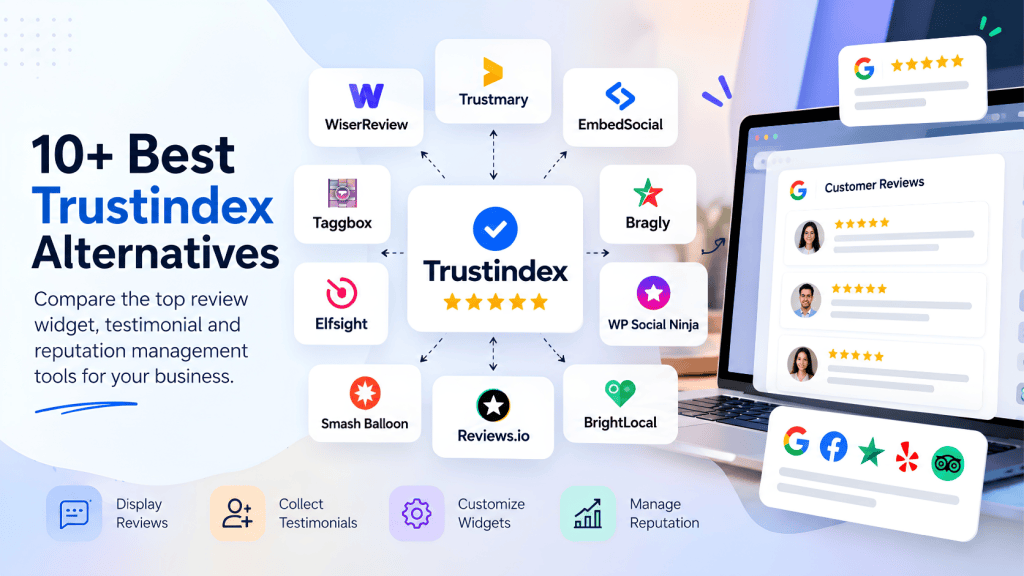
Trustindex is a popular way to bring reviews from platforms such as Google and other review sites onto your website. But displaying existing reviews is only one part of the social-proof equation.
As businesses grow, they often want more. Maybe you need to collect new testimonials instead of only importing old ones. Perhaps you want photo and video reviews, better WordPress customization, more control over multiple review sources, or a platform that also helps with review requests and reputation management.
That’s where Trustindex alternatives come in.
There isn’t one replacement that makes sense for every business. A small local business looking for a simple Google Reviews widget has very different requirements from an ecommerce brand collecting photo reviews or an agency managing reputation across dozens of locations.
In this guide, we’ll compare 10+ Trustindex alternatives based on what they actually help you do: collect reviews, aggregate existing reviews, create website widgets, gather testimonials, manage multiple locations, and turn customer feedback into useful social proof.
Note: Pricing, free-plan limits, integrations, and product features can change. Check the vendor’s current pricing and documentation before making a purchase.
Quick Comparison of Trustindex Alternatives
| Platform | Best for | Free option | Review aggregation | Review collection | Video testimonials | WordPress | WordPress |
|---|---|---|---|---|---|---|---|
| WiserReview | Review collection and display | Yes | Yes | Yes | Yes | Yes | Yes |
| Trustmary | Feedback and testimonials | Yes | Yes | Yes | Yes | Yes | Yes |
| EmbedSocial | Reviews + social content | Yes | Yes | Yes | Limited/varies | Yes | Yes |
| Bragly | Public reviews + fresh customer proof | Yes | Yes | Yes | Yes | Yes | Yes |
| Taggbox | Reviews, UGC and social proof | Yes | Yes | Yes | UGC support | Yes | Yes |
| Elfsight | No-code website widgets | Yes | Yes | Limited/varies | Varies | Yes | Varies |
| WP Social Ninja | WordPress social/review management | Yes | Yes | Yes | Varies | Yes | Yes |
| Smash Balloon | WordPress review feeds | Yes | Yes | Limited | Varies | Yes | Varies |
| Reviews.io | Ecommerce review collection | Varies | Yes | Yes | Yes | Yes | Yes |
| BrightLocal | Local SEO and reputation management | Trial/paid | Yes | Yes | Limited | N/A | Yes |
| Birdeye / Yext / Uberall | Enterprise reputation management | Demo/trial | Yes | Yes | Varies | Integrations | Yes |
The key thing to remember is that these aren’t all direct substitutes. Some are primarily review widgets, some focus on testimonial collection, and others are full reputation-management platforms.
What Is Trustindex?
Trustindex is a review-management and website widget platform built around aggregating customer reviews from multiple review platforms and displaying them on websites.
Its current pricing page lists support for 133 review platforms, along with website widgets, automatic review updates, multiple widget layouts and unlimited websites/widgets/views/reviews on its paid plans. Trustindex also currently offers a free package, while its paid plans start at $65 per year for one company.
This makes it particularly useful for businesses that already have customer reviews spread across different platforms and want to bring those reviews onto their website.
What does Trustindex do?
At its core, Trustindex handles three jobs:
Collect review data from supported platforms → organize/display it → embed it on your website.
Depending on the setup, businesses can display reviews using:
- Sliders
- Grids
- Lists
- Badges
- Floating widgets
- Popups
- Review certificates
- Trustmarks
Trustindex’s current pricing page lists 36 widget layouts and a range of display formats, including slider, grid, badge, button, floating and list layouts.
Who is Trustindex designed for?
Trustindex makes sense when your primary requirement is:
“I already have reviews. I want to bring them together and display them professionally on my website.”
The decision gets more complicated when your requirement becomes:
“I want to actively collect new reviews, create video testimonials, run review campaigns, manage responses, analyze customer sentiment and handle multiple locations.”
That’s where some alternatives become more interesting.
What should users consider before choosing Trustindex?
The most important questions are:
- Do you need only review aggregation?
- Do you need to collect new feedback?
- Do you need photo or video testimonials?
- Do you want monthly billing?
- Do you need advanced moderation?
- Do you manage several locations?
- Do you need broader reputation management?
- Is WordPress your primary platform?
The answer to those questions can change which Trustindex alternative makes the most sense.
Why Look for a Trustindex Alternative?
Trustindex itself isn’t necessarily the problem. In many cases, it’s a perfectly reasonable solution.
People usually start looking for alternatives when their requirements change.
You need to collect new customer reviews
There’s a major difference between displaying existing reviews and generating new ones.
A review widget can show what customers have already said on Google, Facebook, Tripadvisor or another platform.
A review-collection platform goes one step further. It can help you ask customers for feedback through channels such as email, SMS or messaging, then turn positive experiences into public reviews or website testimonials.
WiserReview, for example, positions itself around collecting text, photo and video reviews as well as displaying them through website widgets.
Trustmary takes an even broader feedback-first approach, combining surveys, feedback, review requests, testimonial collection and website display.
You want photo or video testimonials
Written reviews are useful, but they’re no longer the only form of social proof worth collecting.
For some businesses, a 30-second customer video can communicate more trust than a paragraph of text.
This is particularly relevant to:
- SaaS companies
- Consultants
- Agencies
- Coaches
- Service businesses
- Ecommerce brands
If video testimonials are central to your strategy, don’t choose a platform based purely on how many review sources it supports.
You need more customization
A review widget should feel like part of your website, not an advertisement for the widget provider.
Depending on the platform, customization can include:
- Colors
- Fonts
- Spacing
- Layout
- Review filtering
- CSS
- Branding
- Review order
- Responsive behavior
If you’re building a highly customized website, these details can matter more than the raw number of review sources.
You prefer monthly pricing
Pricing structure is another common reason to compare alternatives.
Trustindex’s official pricing currently starts at $65/year for its Single plan, with Pro at $125/year and Ultimate at $349/year. Its pricing page also lists a free package that can be used indefinitely.
This is worth pointing out because some third-party comparison articles still describe Trustindex as having no free plan. For current pricing information, the vendor’s own pricing page should take precedence over older comparison articles.
You need more than a review widget
If your marketing team needs:
- Review requests
- Review monitoring
- Review responses
- Sentiment analysis
- Customer feedback surveys
- Analytics
- Multi-location management
then you’re no longer just looking for a widget.
You’re looking for review or reputation-management software.
You need a different WordPress workflow
WordPress users may prefer a native plugin, Gutenberg block, shortcode or Elementor integration.
Others may prefer a hosted widget that doesn’t add much functionality to their WordPress installation.
That distinction becomes particularly important when website performance and maintenance are concerns.
Trustindex vs Review Management Platforms
One of the easiest mistakes to make when comparing Trustindex alternatives is treating every product as though it solves the same problem.
It doesn’t.
| Capability | Review Widget | Review/Testimonial Platform | Reputation Platform |
| Display reviews | ✓ | ✓ | ✓ |
| Import reviews | ✓ | ✓ | ✓ |
| Collect new reviews | Varies | ✓ | ✓ |
| Review requests | Limited/varies | ✓ | ✓ |
| Review responses | Limited/varies | Varies | ✓ |
| Sentiment analysis | Rare | Varies | ✓ |
| Multi-location | Varies | Varies | ✓ |
| Reporting | Basic | ✓ | ✓ |
| Website widgets | ✓ | ✓ | ✓ |
When a review widget is enough
Choose a review widget solution when your main objective is:
“Show my existing Google, Facebook or other reviews on my website.”
You don’t necessarily need a full reputation platform for that.
When you need a testimonial platform
A testimonial platform makes more sense when you’re actively collecting customer stories.
For example:
- Customer completes a feedback survey.
- Happy customer is invited to leave a review.
- Strong feedback is collected as a testimonial.
- Customer provides a photo or video.
- The testimonial is added to a website widget or case study.
That is a very different workflow from simply importing existing reviews.
When you need full reputation management
Larger organizations may need to monitor reviews across dozens or hundreds of locations, send review requests, respond to customers and manage reputation metrics.
That’s where platforms such as BrightLocal, Birdeye, Yext or Uberall become more relevant than a conventional review widget.
10 Best Trustindex Alternatives
1. WiserReview
WiserReview is one of the more direct Trustindex alternatives if your goal extends beyond simply displaying existing reviews.
Its core difference is the review-collection workflow.
Instead of only importing reviews from external sources, WiserReview focuses on collecting text, photo and video reviews through channels such as email, SMS and WhatsApp, then managing and displaying those reviews. Its current Trustindex comparison highlights automated review requests, multi-location support and a range of display widgets.
Key features
- Text reviews
- Photo reviews
- Video reviews
- Review requests
- Automated follow-ups
- Review management
- Review widgets
- Multiple locations
- CSV import
- AI moderation
Best for
Businesses that want to build a review-generation system, rather than simply display reviews they already have.
Keep in mind
WiserReview is a broader workflow than a basic review widget. If you only need a simple Google Reviews embed, some lighter tools may be easier.
2. Trustmary
Trustmary takes a feedback-first approach.
Instead of starting with:
“Where are your existing reviews?”
the platform is designed around:
“What are your customers saying, and how can you turn that feedback into reviews and testimonials?”
Trustmary’s own Trustindex comparison highlights feedback collection, review requests, review imports, testimonials and website widgets.
Key features
- Surveys
- Customer feedback
- Review requests
- Testimonials
- Review imports
- Website widgets
- Video testimonials
- Feedback metrics
Best for
Service businesses and teams that want to connect customer feedback → reviews → testimonials → website content.
Keep in mind
Trustmary can be more than you need if your only requirement is a small Google Reviews widget.
3. EmbedSocial
EmbedSocial is particularly interesting for businesses that want reviews and social content together.
Its review widget product can bring together sources such as Google, Facebook, Trustpilot and Yelp, then display them as carousels, grids or sliders. The platform also includes social-media content widgets, moderation and filtering.
Key features
- Google Reviews
- Facebook Reviews
- Trustpilot
- Yelp
- Social media aggregator
- Review widgets
- Moderation
- Filters
- Tags
- Multiple widget types
- API access
- Localization
EmbedSocial’s current pricing page lists paid plans beginning at €29/month when billed monthly, with higher tiers adding more sources, views, analytics and social-listening functionality.
Best for
Brands that don’t see reviews and social content as separate things.
For example, an ecommerce brand might want a product page that contains:
Google Reviews + Instagram UGC + customer photos + social posts
instead of maintaining separate systems for each.
4. Bragly
Bragly takes a slightly different approach to the Trustindex replacement problem.
It combines public review aggregation with new customer-proof collection.
Its current Trustindex comparison says Bragly connects with more than 47 review platforms and offers text and video collection forms, moderation, analytics, AI-assisted review responses and multiple display layouts. Its free plan currently supports up to 100 reviews, with Pro starting at $14/month.
Key features
- 47+ review sources
- Review aggregation
- Text testimonials
- Video testimonials
- Review moderation
- Tags and filters
- Analytics
- AI-assisted responses
- Website widgets
- Wall of Love pages
Best for
Businesses that have reviews scattered across many platforms but also want to start collecting new customer proof.
That makes it a closer fit to a modern social-proof workflow than a simple review-display plugin.
5. Taggbox
Taggbox is a strong option when reviews are only one part of your social-proof strategy.
Its Google Reviews widget lets businesses connect a Google Business Profile, customize the display and embed the resulting widget on their website. The current free plan includes one connected social or review feed, 500 monthly views, 500 posts per feed and updates every four days.
Beyond Google Reviews, Taggbox supports multiple social and review sources, moderation and UGC-based content. That makes it relevant to businesses that want to combine reviews, social content and customer-generated content in one website experience.
Key features
- Google Reviews feed
- Google Ratings Badges
- Google Star Rating
- Aggregated Schema Rating
- Multi-platform review aggregation
- Social media feeds
- UGC
- Moderation
- Widget customization
- Multiple layouts
- WordPress compatibility
- Website embeds
- Free Google Reviews widget
Best for
Brands that want more than a conventional review plugin.
For example, a business could use the same broader ecosystem to display:
- Google Reviews
- Instagram posts
- Customer photos
- UGC
- Social feeds
on different parts of the website.
Keep in mind
The free plan has usage limits. Taggbox currently lists 500 monthly views for its free Google Reviews widget, so high-traffic websites should review the paid plans before making a long-term decision.
6. Elfsight
Elfsight is a good fit when Google Reviews are just one of several widgets you need on a website.
Its Google Reviews widget includes review filtering, customizable layouts, review sorting and a review-request button. Elfsight also operates a much wider ecosystem of website apps.
The current Google Reviews pricing page lists a free plan with one widget and 200 monthly views, while paid plans start at $4/month when billed yearly for the Basic tier.
Key features
- Google Reviews
- Review filtering
- Review sorting
- Multiple layouts
- Review request CTA
- No-code setup
- Large website-widget ecosystem
Best for
Website owners who may also need:
- Forms
- Chat
- Instagram feeds
- Social widgets
- Calendars
- Popups
- Other website utilities
Keep in mind
Elfsight is more of a broad website widget platform than a dedicated reputation-management system.
7. WP Social Ninja
WP Social Ninja is a WordPress-focused option for businesses that want reviews and social content managed from within their WordPress environment.
The platform covers more than Google Reviews, including social feeds and other integrations.
Key features
- Google Reviews
- Social feeds
- Review widgets
- Multiple sources
- WordPress integration
- Gutenberg
- Page-builder compatibility
- Review customization
Best for
WordPress users who want to keep social feeds and customer reviews closer to their WordPress workflow.
Keep in mind
Its broader feature set can be useful if you’re managing multiple social widgets, but it may be unnecessary if your only requirement is a small Google Reviews feed.
8. Smash Balloon
Smash Balloon takes a strong WordPress-first approach.
Its Reviews Feed product is designed around displaying customer reviews from supported platforms through customizable WordPress feeds.
Key features
- WordPress-native workflow
- Review feeds
- Google Reviews
- Multiple feed displays
- Shortcodes
- Blocks
- Customization
- Responsive layouts
Best for
Website owners who prefer established WordPress plugins rather than a standalone hosted reputation platform.
Keep in mind
Smash Balloon makes the most sense when your website itself is the center of the workflow. Businesses looking for broader review collection and reputation management may need something more specialized.
9. Reviews.io
Reviews.io is better suited to businesses that want to collect verified reviews rather than simply display reviews from other platforms.
That distinction makes it particularly relevant to ecommerce companies.
Key features
- Review collection
- Verified customer reviews
- Product reviews
- Photo/video content
- Review widgets
- Google review integration
- Ecommerce workflows
Best for
Ecommerce brands that want customer reviews to support both conversion and reputation.
Keep in mind
If your only need is:
“Show my Google Business Profile reviews on my homepage,”
a simpler widget can be more appropriate.
10. BrightLocal
BrightLocal sits further toward the local SEO and reputation-management side of the market.
It’s a better fit when reviews are part of a wider local-search strategy.
Key features
- Local SEO
- Review management
- Review requests
- Citation management
- Local rank tracking
- Reporting
- Multi-location workflows
Best for
Agencies and businesses that care about more than website review widgets and need review management alongside local SEO.
Keep in mind
BrightLocal isn’t a direct one-for-one replacement for a basic Trustindex widget. It’s a broader local SEO platform.
11. Birdeye, Yext and Uberall
For large organizations, a simple review-widget platform may eventually become too limited.
Enterprise reputation platforms such as:
- Birdeye
- Yext
- Uberall
- SOCi
focus on broader workflows such as:
- Review monitoring
- Review requests
- Review responses
- Multi-location management
- Reputation analytics
- Local listings
- Enterprise reporting
Best for
Large brands, franchises, agencies and organizations managing significant numbers of locations.
Keep in mind
These tools are in a different category from lightweight website widgets. Their pricing, setup and feature sets are designed for more complex operational requirements.
Best Trustindex Alternatives by Use Case
Instead of asking:
“Which Trustindex alternative is number one?”
a better question is:
“What exactly am I trying to replace?”
| If you need… | Look at… |
| A simple review widget | Elfsight, Taggbox |
| Google Reviews + social content | Taggbox, EmbedSocial |
| Review collection | WiserReview, Trustmary |
| Video testimonials | Trustmary, WiserReview, Bragly |
| Many public review sources | Bragly, Trustindex, EmbedSocial |
| WordPress-first implementation | WP Social Ninja, Smash Balloon |
| Ecommerce review collection and shoppable UGC | Taggbox |
| Local SEO + reputation management | BrightLocal |
| Enterprise reputation management | Birdeye, Yext, Uberall |
| Reviews + broader social proof | Taggbox, EmbedSocial |
This way of comparing products is much more useful than declaring a single winner without knowing what the buyer actually needs.
Trustindex Alternatives for WordPress
WordPress users have a few additional things to consider.
A platform may technically support WordPress but still require a third-party script, custom embed or external dashboard.
A WordPress-focused plugin may instead offer:
- Gutenberg blocks
- Shortcodes
- Widgets
- Elementor integration
- WordPress customization
- Local caching
- Native settings
WordPress plugin vs hosted widget
A WordPress plugin is installed and maintained on your website.
A hosted widget usually handles the data and widget infrastructure externally, then loads the finished display on your page.
Neither approach is automatically better.
A plugin may offer tighter WordPress integration, while a hosted widget can reduce the amount of functionality you need to manage inside WordPress.
What to check before replacing Trustindex on WordPress
Before switching, check:
- Does it work with Gutenberg?
- Does it support Elementor?
- Can it use shortcodes?
- How is review data loaded?
- Does it cache content?
- How often does it synchronize?
- Does it add branding?
- How many third-party scripts does it load?
- Does it support multiple locations?
- Can you customize the design with CSS?
The technical details matter because two widgets that look almost identical can behave very differently under the hood.
Trustindex Alternatives for Google Reviews
If your actual requirement is simply Google Reviews, don’t get distracted by platforms that solve an entirely different problem.
Start by deciding which of these describes your goal.
Display existing Google Reviews
A straightforward review widget may be enough.
Collect new Google Reviews
Look for review-request and feedback workflows.
Combine Google Reviews with other sources
Choose a multi-source aggregator.
Combine Google Reviews with social content
Platforms such as Taggbox and EmbedSocial become more relevant.
Manage reviews across multiple locations
Look toward reputation-management platforms.
Google Reviews and SEO
Displaying Google Reviews can add useful social proof and relevant customer content to a page, but it shouldn’t be treated as an automatic ranking shortcut.
The same goes for structured data.
A plugin offering review schema does not mean Google will automatically display review stars for the business.
Free Trustindex Alternatives
Free is one of the most attractive words in this search query, but it’s also one of the easiest to misunderstand.
A “free” plan may have limits on:
- Monthly views
- Widgets
- Reviews
- Sources
- Locations
- Branding
- Synchronization
- Features
Does Trustindex have a free plan?
Yes. Trustindex’s current official pricing page lists a Free Package that can be used forever. Paid packages can be tried for seven days before falling back to the free package.
That is an important correction to some third-party Trustindex comparison pages that still describe the service as having no free plan. WiserReview’s article, for instance, currently says Trustindex has no free plan, which conflicts with Trustindex’s official pricing page.
Some free alternatives worth checking
Taggbox currently offers a free Google Reviews widget with 500 monthly views and unlimited website embeds
Elfsight currently offers one Google Reviews widget and 200 monthly views on its free plan.
Bragly currently advertises a free plan supporting up to 100 reviews.
The right free option depends on whether your priority is views, reviews, design, sources or review collection.
Trustindex Pricing vs Alternatives
Trustindex currently lists:
- Single: $65/year
- Pro: $125/year
- Ultimate: $349/year
The paid plans include unlimited websites, widgets, views and reviews, with different company limits.
But price alone doesn’t tell you whether one platform is more suitable.
For example:
A tool costing $10/month that only displays Google Reviews isn’t necessarily better value than a $30/month platform that also collects video testimonials, handles review requests and manages multiple review sources.
Likewise, paying more for a reputation-management platform doesn’t make sense if all you need is a review slider on your homepage.
Compare cost against functionality
Before choosing, ask:
- How many websites do I need?
- How many locations do I manage?
- How many review sources do I use?
- Do I need to collect reviews?
- Do I need video testimonials?
- How much traffic does the widget receive?
- Do I need analytics?
- Do I need review management?
- Do I need an agency account?
That’s where the real pricing comparison starts.
Trustindex Alternatives for Review Collection
This is one of the strongest reasons to look beyond a traditional review aggregator.
Imagine a customer completes a project with your company.
Instead of waiting and hoping they leave a Google review, a review-collection platform can help you actively request feedback.
The process might look like:
Customer interaction → feedback request → customer response → public review/testimonial → website display
You can then turn particularly strong feedback into:
- Website testimonials
- Case studies
- Review widgets
- Sales-page social proof
- Video testimonials
- Social media content
Platforms such as WiserReview and Trustmary are designed much closer to this workflow than a straightforward aggregation widget.
Trustindex Alternatives for Agencies
Agencies have a different set of requirements.
You’re not managing one business. You might be managing:
- 10 websites
- 20 Google Business Profiles
- Multiple client domains
- Different review sources
- Different widget designs
- Separate client permissions
That makes features such as these particularly important:
Multiple accounts
Can you manage several clients from one dashboard?
White labeling
Can the agency remove or minimize vendor branding?
Reporting
Can you show clients what happened to their reviews and widgets?
Centralized management
Can several client accounts be managed without constantly switching between unrelated dashboards?
Automation
Can the system automate review requests and routine workflows?
For larger agency operations, dedicated reputation platforms can make more sense than a simple widget subscription.
Trustindex Alternatives for Multi-Location Businesses
The requirements become even more complicated when one business has many locations.
Imagine a restaurant chain with 50 locations.
You may need to:
- Connect 50 Google Business Profiles
- Monitor reviews by location
- Respond to customers
- Compare locations
- Identify recurring problems
- Report to regional managers
- Display location-specific reviews on individual pages
A basic review widget is not designed for all of that.
In such cases, reputation-management platforms such as BrightLocal, Birdeye, Yext or Uberall may be more appropriate.
How to Choose the Right Trustindex Alternative
Start with the job you need the software to do.
Do you only need a review widget?
Look at lightweight widget solutions.
Do you need to collect new reviews?
Prioritize review-collection platforms.
Do you need video testimonials?
Look for platforms that support video collection and reuse.
Do you need multiple review sources?
Choose an aggregator.
Do you need WordPress?
Look for native plugins, blocks, shortcodes and page-builder support.
Do you manage several locations?
Look for multi-location reputation management.
Do you need an agency workflow?
Prioritize centralized accounts, reporting and client management.
Do you need full reputation management?
A widget alone is unlikely to be enough.
How to Switch From Trustindex
Switching platforms doesn’t need to be disruptive, but it shouldn’t be treated as simply deleting one plugin and installing another.
Step 1: Document your current setup
Before making changes, record:
- Review sources
- Existing widgets
- Pages using Trustindex
- Shortcodes
- Custom CSS
- Widget layouts
- Branding settings
- Locations
Step 2: Choose the replacement
Create the equivalent widgets in your new platform.
Step 3: Connect your review sources
Reconnect Google Business Profiles and other review platforms.
Step 4: Recreate your layouts
Try to match the existing design where possible, but don’t be afraid to simplify it.
Step 5: Replace the existing embeds
Update your WordPress blocks, shortcodes or website embeds.
Step 6: Test everything
Check:
- Desktop
- Mobile
- Tablet
- Widget loading
- Review updates
- Links
- Buttons
- Layout
- Branding
Step 7: Test performance
Check whether the new platform changes:
- LCP
- INP
- CLS
- JavaScript execution
- Third-party requests
Step 8: Remove Trustindex
Only remove the old implementation after the replacement has been tested successfully.
Will Switching From Trustindex Affect SEO?
Replacing a review widget does not inherently mean losing your organic rankings.
The risk comes from how the migration is implemented.
Pay attention to:
- URL changes
- Content changes
- Internal links
- JavaScript rendering
- Structured data
- Page performance
- Indexability
If the widget is replaced but the surrounding page remains intact, the migration is very different from completely rebuilding the page.
After deployment, monitor:
- Search Console
- Organic traffic
- Rankings
- Indexing
- Core Web Vitals
and investigate any meaningful changes rather than assuming that the new widget caused them.
Frequently Asked Questions About Trustindex Alternatives
What is the best Trustindex alternative?
It depends on what you want to replace.
For simple review display, a widget-focused tool may be enough. If you need review collection, video testimonials or broader reputation management, a more comprehensive platform may be a better fit.
Is there a free Trustindex alternative?
Yes. Several alternatives offer free tiers or free widgets, including Taggbox, Elfsight and Bragly. Their limits differ, so compare views, reviews, widgets and features rather than looking only at the word “free.” (taggbox.com; elfsight.com; bragly.io)
Does Trustindex have a free plan?
Yes. Trustindex’s official pricing page currently lists a Free Package that can be used indefinitely. (trustindex.io)
How much does Trustindex cost?
Trustindex currently lists paid plans starting at $65/year for its Single plan, followed by $125/year for Pro and $349/year for Ultimate. (trustindex.io)
Why should I switch from Trustindex?
Common reasons include wanting review collection, video testimonials, additional customization, different pricing, broader social-proof functionality or full reputation management.
What is the best Trustindex alternative for WordPress?
There isn’t one universal answer. WordPress-focused users can evaluate solutions such as WP Social Ninja and Smash Balloon, while hosted platforms such as Taggbox, Elfsight and EmbedSocial can also be embedded into WordPress.
What is the best Trustindex alternative for Google Reviews?
For a simple Google Reviews display, compare widget-focused tools such as Taggbox and Elfsight. For a larger review-management workflow, consider platforms that also provide collection and management features. (taggbox.com; elfsight.com)
Which Trustindex alternative supports video testimonials?
Platforms such as WiserReview, Trustmary and Bragly support workflows that go beyond text reviews and can include video testimonials or customer stories. (wiserreview.com; trustmary.com; bragly.io)
Which Trustindex alternative can collect new reviews?
WiserReview and Trustmary are examples of platforms built around review or feedback collection in addition to website display. (wiserreview.com; trustmary.com)
Which Trustindex alternative has monthly pricing?
Several alternatives use monthly subscriptions. For example, WiserReview lists monthly plans, while Elfsight offers monthly pricing based on the selected widget plan. Pricing can change, so check the current pricing page before purchasing. (wiserreview.com; elfsight.com)
What is the cheapest Trustindex alternative?
There isn’t a meaningful universal answer because free tiers and paid limits differ.
A $4/month widget with a 200-view limit and a $14/month platform supporting 100 reviews are solving different problems. Compare the amount of functionality you actually need instead of looking only at the monthly price.
Can I use Taggbox instead of Trustindex?
Yes. Taggbox can be used to collect and display Google Reviews and other social/review content through website widgets. Its current Google Reviews widget has a free plan with 500 monthly views.
Trustindex vs Trustmary: what’s the difference?
Trustindex is strongly oriented toward aggregating and displaying existing reviews, while Trustmary places greater emphasis on feedback collection, review requests, testimonials and the workflow between customer feedback and public social proof.
Trustindex vs WiserReview: what’s the difference?
WiserReview focuses more heavily on collecting text, photo and video reviews, automated review requests and managing the resulting customer content. Trustindex is more focused on review aggregation and website display.
Trustindex vs EmbedSocial: what’s the difference?
EmbedSocial combines review widgets with broader social-media and UGC aggregation. It can bring Google, Facebook, Trustpilot, Yelp and social content into website widgets. (embedsocial.com)
Can I migrate from Trustindex?
Yes. A typical migration involves documenting your existing widgets, recreating them in the new platform, replacing the embeds, testing the new implementation and then removing Trustindex.
Will replacing Trustindex affect my SEO?
Not necessarily. The main concern is whether the migration changes the page’s content, URL, internal linking, structured data or technical performance. Monitor organic traffic and Search Console after the change.
How We Evaluated These Trustindex Alternatives
A useful alternative comparison shouldn’t be based purely on a feature-count race.
The platforms in this guide should be evaluated using criteria such as:
- Review-source coverage
- Review aggregation
- Review collection
- Widget functionality
- Customization
- Photo and video support
- WordPress compatibility
- Integrations
- Multi-location support
- Automation
- Analytics
- Pricing
- Free-plan limitations
- Performance
- Ease of migration
Just as importantly, product claims should be verified against the current official documentation.
That’s particularly important for Trustindex because some third-party articles currently contain outdated information about its free plan, while its official pricing page now lists a free package. (trustindex.io)
Conclusion
Trustindex alternatives aren’t all competing for exactly the same customer.
Some are better understood as review widgets. Others are testimonial collection platforms. Others are UGC and social proof tools , while enterprise products move into full reputation management.
That distinction makes choosing a replacement much easier.
If you already have thousands of reviews scattered across public platforms and simply need them displayed on your website, look for a strong review aggregator.
If you’re trying to generate more reviews, look for a platform that can automate collection.
If customer stories, photos and videos are becoming a major part of your marketing, prioritize testimonial tools.
And if you’re managing dozens of locations, you’ll probably need something much closer to a reputation-management platform than a basic widget.
The most useful question isn’t:
“Which Trustindex alternative is the best?”
It’s:
“What do I need my review platform to do that Trustindex isn’t doing for me?”
Once you answer that, the shortlist usually becomes much smaller.
Looking for more than a basic review widget?
Explore Taggbox’s Google Reviews and review widget solutions to collect, customize, moderate and display customer feedback across your website.
Start with the free option and scale when your traffic and social-proof requirements grow. Taggbox currently offers a free Google Reviews widget with 500 monthly views and support for additional social and review sources.
Start building your Google Reviews widget today.









Leave a comment