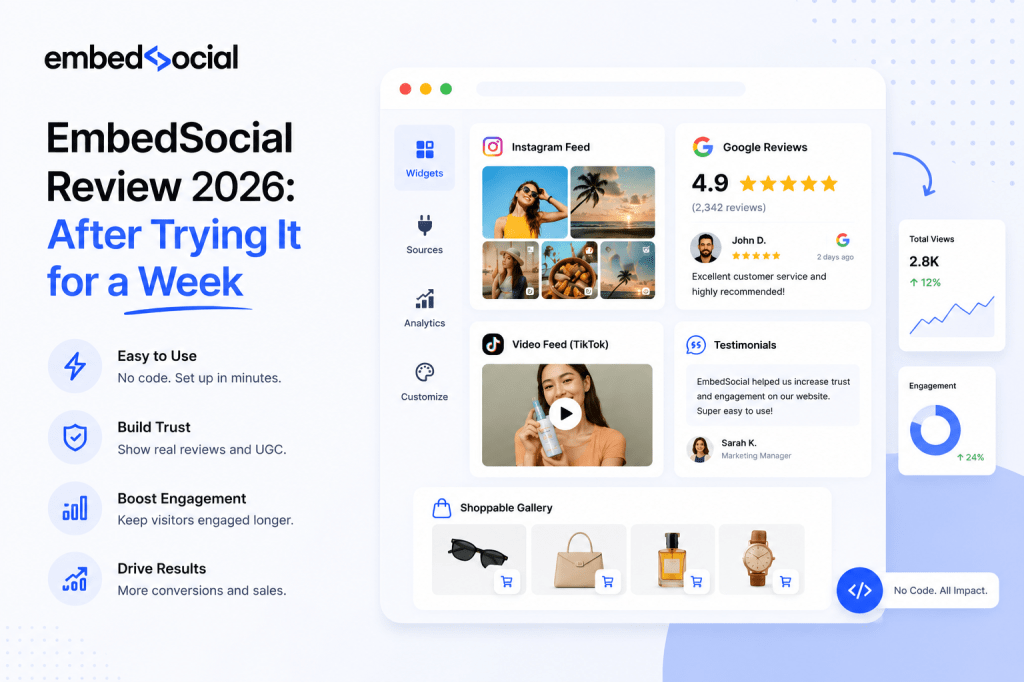
EmbedSocial is a social media and review widget platform that helps businesses embed Instagram feeds, Google reviews, TikTok videos, testimonials, and user-generated content on websites without custom development. After testing EmbedSocial for a week across multiple use cases — including review widgets, Instagram feeds, and ecommerce-style UGC galleries — the platform feels strongest for businesses that actively rely on:
- social proof,
- visual marketing,
- customer reviews,
- and user-generated content.
Its biggest advantages are:
- fast setup,
- modern widget designs,
- strong Instagram integrations,
- review aggregation,
- and ecommerce-friendly features.
However, the platform also comes with some tradeoffs, especially around:
- pricing scalability,
- page speed impact,
- API dependency,
- and advanced customization flexibility.
If you’re considering EmbedSocial for your website, this review breaks down:
- features,
- real-world usability,
- SEO impact,
- performance,
- pricing,
- pros and cons,
- and whether it’s actually worth using in 2026.
What Is EmbedSocial?
EmbedSocial is a cloud-based social proof platform designed to help businesses collect and display content from social media platforms and review sites directly on their websites.
Instead of manually uploading screenshots of reviews or updating social galleries every few days, the platform automatically syncs content from:
- Instagram,
- TikTok,
- Facebook,
- YouTube,
- Google Reviews,
- and other sources
into embeddable widgets.
The company positions itself as more than just an Instagram feed tool.
The platform now focuses heavily on:
- user-generated content (UGC),
- review marketing,
- social commerce,
- website engagement,
- and conversion optimization.
That positioning becomes obvious once you start using the product.
Most of the platform’s newer features revolve around helping businesses turn social content into conversion-focused website experiences rather than simply displaying feeds for aesthetics.
My First Impression After Using EmbedSocial
The first thing that stood out during testing was how aggressively the platform focuses on usability.
Most social widget platforms claim to be “no-code,” but many still feel clunky once you actually start configuring layouts, moderation rules, or integrations.
EmbedSocial is noticeably cleaner than many older social feed tools.
The onboarding flow is simple:
- connect accounts,
- choose widget type,
- customize layout,
- generate embed code.
For a basic implementation, the process takes very little time.
I tested:
- Instagram feed widgets,
- Google review widgets,
- testimonial sliders,
- and shoppable galleries
across both a WordPress site and a Shopify test store.
The widgets generally looked polished out of the box without requiring heavy styling adjustments, which is important because poor widget design immediately lowers perceived website quality.
This is one area where EmbedSocial performs well compared to many cheaper alternatives.
Key Features I Tested
Instagram Feed Widgets
Instagram integration is clearly one of the platform’s biggest priorities.
I tested:
- standard feed embeds,
- hashtag feeds,
- reels,
- tagged content,
- and story-style layouts.
The syncing process was relatively smooth, and the widgets updated automatically after account connection.
From a visual perspective, the layouts feel modern enough for ecommerce websites without looking outdated or overly template-driven.
What I liked most was the flexibility in presentation.
Instead of forcing one rigid layout style, the platform allows businesses to adjust:
- spacing,
- card styles,
- feed formats,
- typography,
- and CTA behavior.
That flexibility becomes important when trying to make third-party widgets feel native to a website design.
Google Review Widgets
The review widget system is probably the strongest commercial feature inside EmbedSocial.
I tested Google review embeds on:
- homepage sections,
- local service pages,
- and landing pages.
The platform supports multiple display styles including:
- sliders,
- floating badges,
- carousels,
- and testimonial grids.
The biggest advantage here is automation.
Instead of manually updating testimonials every month, the reviews sync dynamically from connected profiles.
For local businesses especially, this creates a much more active and trustworthy experience.
Static testimonials often feel outdated very quickly. Fresh reviews feel significantly more authentic.
That said, businesses should understand something important:
Embedding reviews does not automatically improve SEO rankings directly.
The value is more behavioral and conversion-focused:
- stronger trust,
- higher engagement,
- improved buyer confidence,
- and potentially better conversion rates.
Shoppable UGC Galleries
This is where EmbedSocial starts separating itself from simpler feed embed tools.
I tested the platform’s shoppable gallery functionality on a Shopify demo store, connecting Instagram posts directly to products.
The workflow is designed around social commerce.
Instead of treating Instagram content as decorative media, the platform allows businesses to turn social posts into clickable product discovery experiences.
For ecommerce brands, especially in:
- fashion,
- beauty,
- fitness,
- travel,
- and lifestyle niches,
this functionality makes much more sense than traditional static galleries.
Modern buyers trust real customer content far more than overly polished product photography.
The ability to connect:
- customer posts,
- influencer content,
- creator videos,
- and UGC
directly into the shopping journey can genuinely improve engagement.
This is probably one of the platform’s strongest use cases.
How Easy Is EmbedSocial to Use?
Overall usability is one of the platform’s strongest qualities.
Many social aggregation tools become complicated once you start:
- moderating content,
- managing multiple sources,
- handling layouts,
- or scaling widgets.
EmbedSocial keeps most workflows relatively straightforward.
Even non-technical users can usually:
- connect platforms,
- customize widgets,
- and publish embeds
without developer involvement.
For agencies, the centralized dashboard is also useful because managing multiple social widgets manually across client websites becomes inefficient very quickly.
However, once you move beyond basic customization, limitations start becoming more noticeable.
Advanced design control sometimes requires:
- custom CSS,
- manual styling,
- or developer adjustments.
This is fairly common in the category, but businesses expecting fully custom frontend experiences should be aware of it.
Does EmbedSocial Affect Website Speed?
Yes — and this is probably one of the most important considerations before implementing it heavily.
During testing, page performance impact varied depending on:
- widget size,
- number of feeds,
- content volume,
- and placement strategy.
A single optimized widget generally wasn’t a major issue.
But pages with:
- multiple embeds,
- large galleries,
- autoplay media,
- or several external requests
started showing noticeable performance overhead.
This matters because Google’s ranking systems increasingly prioritize:
- Core Web Vitals,
- interaction responsiveness,
- visual stability,
- and mobile usability.
Heavy social widgets can negatively affect:
- Largest Contentful Paint (LCP),
- Interaction to Next Paint (INP),
- and overall page responsiveness
if implemented carelessly.
The businesses that usually get the best results with platforms like EmbedSocial are the ones using widgets strategically rather than embedding social feeds everywhere simply because they can.
In most cases, high-intent pages benefit more from carefully placed social proof than pages overloaded with unnecessary widgets.
Is EmbedSocial Good for SEO?
Indirectly, yes.
Directly, not necessarily.
This distinction is important.
EmbedSocial can contribute positively to:
- user engagement,
- trust signals,
- content freshness,
- conversion behavior,
- and visual interaction.
Those factors can support broader SEO performance indirectly.
For example:
- review widgets may improve conversion trust,
- UGC galleries may increase dwell time,
- interactive content may improve engagement depth.
However, businesses should not assume that embedded feed content itself acts as highly crawlable SEO content.
Google does not consistently treat embedded widgets as core page content in the same way it treats native HTML copy.
That means widgets should support content — not replace it.
The strongest SEO implementations combine:
- strong editorial content,
- semantic topical depth,
- structured copywriting,
- and selective social proof elements.
Not social feeds alone.
EmbedSocial Pricing: Is It Worth It?
Pricing is where opinions on EmbedSocial tend to become more divided.
For small businesses using:
- a few widgets,
- limited sources,
- or basic review functionality,
the pricing feels manageable.
But as implementation scales across:
- multiple websites,
- multiple brands,
- agencies,
- ecommerce catalogs,
- or advanced UGC campaigns,
costs can increase fairly quickly.
The free plan works mostly as a testing environment rather than a long-term solution.
Most commercially useful features sit behind paid plans, including:
- advanced customization,
- moderation,
- white labeling,
- analytics,
- multiple feeds,
- and ecommerce-focused functionality.
Whether the pricing feels justified depends entirely on how valuable social proof is to the business.
For ecommerce brands heavily dependent on visual trust and creator content, the ROI can absolutely justify the cost.
For simpler websites needing only a lightweight Instagram embed, cheaper tools may be enough.
EmbedSocial Pros and Cons
What I Liked
After testing the platform, the biggest strengths were:
- easy setup,
- polished widget designs,
- strong review functionality,
- modern Instagram integrations,
- ecommerce-focused features,
- and overall usability.
The platform feels much more conversion-oriented than many basic social feed tools.
What Could Be Better
The biggest drawbacks were:
- pricing scalability,
- performance overhead on heavy pages,
- dependency on third-party APIs,
- and some advanced customization limitations.
Businesses implementing multiple widgets at scale should pay close attention to:
- page speed,
- mobile UX,
- and Core Web Vitals performance.
Best Use Cases for EmbedSocial
EmbedSocial works best for businesses where social proof directly influences purchase decisions.
The strongest fit is usually:
- ecommerce brands,
- beauty brands,
- fashion stores,
- restaurants,
- fitness businesses,
- agencies,
- and creator-led brands.
These businesses naturally generate:
- visual content,
- reviews,
- customer media,
- and UGC.
That content becomes significantly more valuable when integrated directly into conversion-focused website experiences.
Best EmbedSocial Alternatives
Depending on your goals, there are several alternatives worth considering.
Taggbox
Taggbox is best for businesses wanting a enterprise standard solution with 24/7 support and aggregation from 20+ platforms along with review collection via QR or forms.
Juicer
Better suited for hashtag aggregation and social campaign displays.
Walls.io
Stronger for live event social walls and conference experiences.
Elfsight
Elfsight offers good lightweight alternative for simpler embed requirements.
Each platform has slightly different strengths depending on whether the priority is:
- ecommerce,
- events,
- affordability,
- customization,
- or broader widget functionality.
Final Verdict: Is EmbedSocial Worth It in 2026?
After testing EmbedSocial for a week, the platform feels strongest for businesses that actively rely on:
- social proof,
- visual commerce,
- customer reviews,
- and user-generated content.
Its biggest advantages are:
- ease of implementation,
- modern widget presentation,
- strong review integrations,
- and ecommerce-friendly UGC functionality.
For ecommerce brands especially, the platform can genuinely help bridge the gap between social engagement and website conversion optimization.
At the same time, businesses should evaluate long-term pricing, scalability,, performance impact and implementation strategy before deploying widgets aggressively across large websites.
EmbedSocial works best when social proof is treated as a strategic conversion asset rather than decorative website content.
When implemented thoughtfully, it can improve trust, engagement, visual credibility, and customer confidence without requiring complex custom development.
NOTE – We use our Unbiased content standards and review methodology to provide collect information and present on our blogs at Widgets Code. If you find any information to be misleading or incorrect, feel free to reach us at widgetscode[@]gmail[dot]com





Leave a Reply